


Vincent van Gogh created some of the most recognisable artworks in modern art history. His expressive brushstrokes, vivid colours, swirling skies and golden landscapes continue to attract people who want to understand the stories behind his work. Paintings such as The Starry Night, Sunflowers and Wheatfield with Crows reveal an artist who transformed familiar subjects into powerful visual experiences.
His artistic journey was relatively short, but it involved remarkable changes in technique, subject matter and colour. From early scenes of rural life to expressive landscapes and flower paintings, his work reflects a constant search for new ways to represent the world. This guide explores his biography, famous masterpieces, artistic style, original artwork, estimated market value and the collections where visitors can discover his paintings.
Van Gogh Paintings Wikipedia: Who Was Vincent van Gogh?
Vincent van Gogh was a Dutch painter born on 30 March 1853 in Zundert, the Netherlands. He became one of the most influential figures associated with Post-Impressionism, a movement that developed after Impressionism and encouraged artists to explore colour, structure and personal expression in new ways.
Van Gogh did not begin his artistic career immediately. He worked for an art dealership, explored religious occupations and spent time considering different professional paths. He eventually committed himself to painting in his late twenties, learning through drawing, observation, study and persistent experimentation.
His earliest important paintings often focused on working people and rural communities. The Potato Eaters, completed in 1885, shows a family sharing a simple meal. Its earthy colours, rough facial features and strong contrasts communicate the physical demands of agricultural life. The painting demonstrates his early interest in representing ordinary people with seriousness and dignity.
A move to Paris in 1886 brought major changes. Van Gogh encountered Impressionist and Post-Impressionist artists, discovered new approaches to colour and became interested in Japanese prints. His palette gradually became brighter, while his compositions developed greater movement and contrast.
In 1888, he moved to Arles in southern France. The sunlight, gardens, fields and architecture of the region provided new subjects. During this period, he created several important works, including the famous Sunflowers series and Café Terrace at Night.
Van Gogh later stayed at Saint-Rémy, where he continued painting landscapes, gardens and portraits. He died on 29 July 1890, aged 37, leaving a substantial body of paintings, drawings and letters.
During his lifetime, he received limited commercial recognition. His reputation grew after his death, helped significantly by his brother Theo’s wife, Johanna van Gogh-Bonger, who preserved his work and correspondence and helped introduce it to wider audiences.
Today, his art is recognised for its originality, expressive power and influence on later modern artists. Understanding his life provides useful context, but his paintings deserve attention for their artistic achievements rather than only the personal difficulties associated with his biography.
What Are the Most Famous Van Gogh Paintings?
Several of Van Gogh’s works have become internationally recognised because of their distinctive compositions, striking colours and enduring artistic influence. Each offers a different perspective on his development as a painter.
The Starry Night
Painted in June 1889, The Starry Night presents a dramatic night sky above a quiet village. Curving bands of blue move across the heavens, while bright stars and a crescent moon create points of intense yellow light. A tall cypress tree rises in the foreground, connecting the landscape with the sky.
Van Gogh created the work while staying at Saint-Paul-de-Mausole in Saint-Rémy. Although the painting draws on his observations of the surrounding landscape, the final composition also includes imaginative elements. It should not be understood as a straightforward record of a single view.
The sky dominates the scene through repeated curves and swirling forms. These marks create a feeling of movement, while the village below appears comparatively still. This contrast gives the composition its distinctive visual tension.
The painting has inspired interpretations involving nature, spirituality, dreams and humanity’s relationship with the universe. However, no single explanation accounts for every detail. Part of its appeal lies in the way its colours and forms allow different viewers to develop their own responses.
The original painting is held by the Museum of Modern Art in New York.
Sunflowers
The Sunflowers series is among Van Gogh’s most recognisable achievements. He painted several versions in Arles between 1888 and 1889, exploring different arrangements of flowers in vases.
In one celebrated composition, fifteen sunflowers appear against a yellow background. Some flowers are open and full, while others have begun to wilt. This variation creates a natural rhythm across the canvas and introduces a subtle awareness of growth, ageing and the passing of time.
Yellow dominates the painting, but the composition is not visually uniform. Changes in tone, orange accents, blue details and thick applications of paint give the flowers individual character.
The series also has an important personal context. Van Gogh prepared the paintings to decorate his house in Arles for the planned visit of fellow artist Paul Gauguin. The flowers therefore relate to friendship, artistic ambition and his hope of establishing a shared working environment.
Van Gogh’s use of thick paint makes the petals and flower heads appear almost sculptural. The marks remain visible, encouraging viewers to notice the physical surface of the canvas as well as the image.
The National Gallery owns a celebrated version, although its display status can change. Other versions are held in collections in Amsterdam, Munich, Philadelphia and Tokyo.
Irises
Van Gogh painted Irises in 1890 while receiving care at Saint-Rémy. The composition focuses on flowers growing in a garden, using vivid colour and expressive outlines to transform a familiar subject.
Blue and violet irises stand against green foliage and lighter areas of ground. The flowers vary in shape and direction, preventing the arrangement from appearing repetitive.
The painting demonstrates how Van Gogh used natural forms as the basis for a carefully organised composition. The flowers remain recognisable, but their placement and colour relationships give the work a strong decorative quality.
Japanese prints influenced his interest in simplified forms, pronounced outlines and unusual cropping. He adapted these ideas to develop his own visual language rather than simply copying another artistic tradition.
The work also illustrates his interest in observing nature closely. Individual petals and leaves contribute to the composition, while the repeated shapes create a sense of unity.
The Bedroom
The Bedroom, painted in 1888, depicts Van Gogh’s room in the Yellow House in Arles. The simple interior includes a bed, chairs, a small table, pictures and other everyday objects.
The painting’s subject is ordinary, but its colour and perspective make it distinctive. Strong blocks of colour separate the walls, floor, furniture and bedding. The outlines are clear, although the perspective appears unusual in places.
Van Gogh was interested in using colour to communicate a feeling of rest and tranquillity. The room can therefore be understood as more than a record of his surroundings: it is also an exploration of how colour can shape the atmosphere of an interior.
He returned to the composition in multiple versions, showing that he regarded the subject as an opportunity for further experimentation.
The painting is particularly useful for understanding how Van Gogh could create an engaging work without choosing an elaborate or dramatic scene. Furniture, walls and familiar objects become the building blocks of a carefully constructed image.
The Potato Eaters
Completed in 1885, The Potato Eaters is one of Van Gogh’s most important early paintings. It depicts a peasant family gathered around a table, sharing a meal under the light of a lamp.
The figures have weathered features and rough hands, reflecting the physical demands of rural work. Van Gogh wanted to represent working people in a way that acknowledged their labour rather than idealising their lives.
Its muted browns, greens and earthy tones differ from the bright colours associated with his later works. The lamp creates a central point of light, drawing attention to the people and the food on the table.
The composition encourages viewers to consider the connection between labour and daily life. The meal is simple, but it represents the results of work and the practical realities of rural existence.
Van Gogh studied peasant figures carefully while developing the painting. He wanted the people to look as though they had earned their food through their own efforts.
The work reveals his early commitment to meaningful subject matter and his willingness to develop an artistic approach that differed from idealised academic painting.
Van Gogh Paintings Starry Night: Meaning and History
The Starry Night is widely recognised for its swirling sky, luminous stars and strong contrast between movement above and stillness below. Its distinctive appearance has made it one of the most discussed works in modern art.
The painting dates from June 1889, when Van Gogh was staying at Saint-Rémy. During this period, he continued studying the landscape around him, making drawings and paintings that explored the changing appearance of fields, trees, hills and skies.
The composition combines observed details with artistic invention. The village and church spire, for example, are not simply a direct transcription of the view from his room. Van Gogh arranged and transformed elements to create a composition that served his artistic aims.
The swirling sky is central to the painting’s effect. Repeated curves carry the viewer’s eye across the canvas, while the stars and moon provide bright focal points. The cypress tree adds a strong vertical shape that links the foreground to the sky.
The work can be interpreted in several ways. Some viewers focus on the contrast between the quiet village and restless heavens, while others consider its spiritual associations or the relationship between humanity and nature.
It is important to distinguish interpretation from documented fact. The painting’s visual qualities can be examined directly, but claims about a single hidden message require stronger evidence than personal impressions alone.
The original is part of the Museum of Modern Art’s collection in New York. It is separate from Starry Night Over the Rhône, an earlier painting that depicts stars and artificial lights reflected in the river at Arles.
Vincent van Gogh Paintings Wheat Field: Famous Landscapes
Wheat fields became an important subject during Van Gogh’s later years. These landscapes allowed him to explore colour, movement, weather and the relationship between cultivated land and the natural environment.
Rather than treating a field as a static background, he often used energetic brushstrokes to give the wheat, grass and sky a strong visual presence. The direction of the marks helps determine how viewers move through the composition.
A Wheatfield, with Cypresses
Painted in 1889, A Wheatfield, with Cypresses combines golden wheat, tall cypress trees, rolling hills and a lively sky. The cypresses rise above the landscape, creating dark vertical shapes against the lighter colours around them.
The painting’s contrast between the moving sky and the textured field gives the scene considerable energy. Green, yellow and blue work together to suggest the changing appearance of the countryside under sunlight.
Van Gogh painted several versions of this subject during his stay at Saint-Rémy. These works demonstrate how he revisited a landscape to explore different arrangements and effects.
Wheatfield with Crows
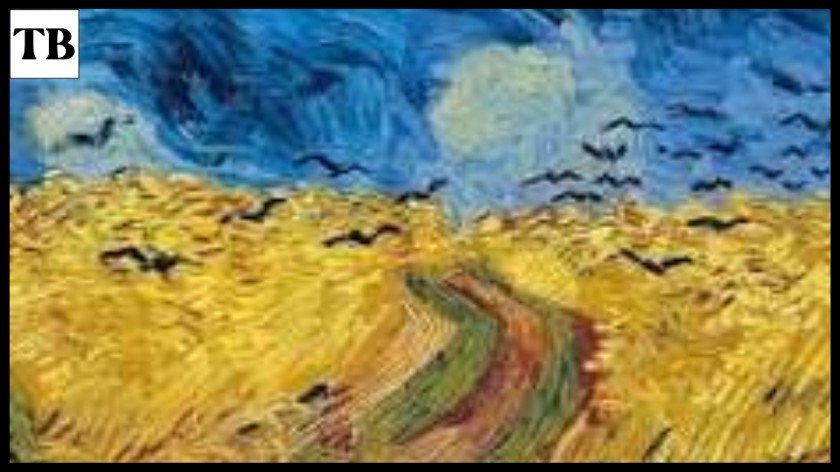
Wheatfield with Crows, painted in 1890, features a broad field beneath a darkening sky. Paths cross the foreground, and crows appear as dark shapes above the wheat.
The composition uses strong directional lines and contrasting colours to create an unsettled atmosphere. The paths guide the eye into the field, while the brushstrokes give the sky and crops a sense of movement.
The painting is often associated with dramatic interpretations of Van Gogh’s final period. However, it is not possible to establish a single definitive meaning from the imagery alone. A careful reading considers the composition, technique and historical context together.
Wheatfield with a Reaper
In Wheatfield with a Reaper, Van Gogh depicts a worker harvesting wheat. The subject connects his later landscape paintings with his longstanding interest in agricultural life and the relationship between people and nature.
The field becomes a major visual element rather than a passive setting. The colour and movement of the wheat help create a sense of activity, while the worker provides a human focus within the landscape.
Together, these paintings demonstrate that wheat fields were more than repeated scenery. They gave Van Gogh opportunities to study the seasons, working life, natural forms and the expressive possibilities of paint.
Original Van Gogh Paintings: How to Identify Authentic Artwork
Original works by Van Gogh are held in museums and private collections around the world. Their historical importance comes from their direct connection to the artist, their place in modern art history and the evidence they provide about his working methods.
However, an original painting should not be confused with a print, poster or decorative reproduction. These are different objects, with different histories and values.
Authenticating a painting requires specialist investigation. Experts may consider the documented ownership history, known exhibitions, materials, technique, condition and relationship to Van Gogh’s established body of work.
Provenance is especially important. It refers to the history of ownership and can help researchers understand how a work moved between individuals and collections. Gaps in provenance do not automatically prove that a painting is false, but they may require further investigation.
Technical examination can provide additional information about pigments, canvas, paint layers and underdrawing. Specialists compare this evidence with historical records and established knowledge of the artist’s practice.
A signature alone does not prove authenticity. Nor does a painting become genuine simply because its colours or brushstrokes resemble Van Gogh’s style.
Anyone considering the purchase of a potentially valuable work should seek independent advice from qualified art specialists. The process is complex, and a reliable conclusion requires more than a visual comparison.
For readers who simply want to study original works, established museum collections provide reliable information about the identity, date and history of individual paintings.
Van Gogh Paintings Price: How Much Are They Worth?
The value of an original Van Gogh painting depends on its authenticity, provenance, condition, subject matter, historical importance and the circumstances of a potential sale.
Major works can achieve exceptionally high prices because relatively few original paintings are available to private buyers. Many of the most important examples are held by public museums and form part of established collections.
A painting’s provenance can influence buyer confidence. A well-documented history may support research into authenticity, while unresolved ownership questions can complicate a valuation.
Condition is another consideration. Damage, previous restoration, fading and changes to the paint surface can affect the way a work is assessed. Conservation specialists may need to examine these factors before an informed opinion is possible.
Subject matter can influence demand, but there is no universal formula for calculating value. A recognisable image may attract significant attention, yet the final price depends on the individual painting and market conditions.
It is also essential to distinguish original paintings from reproductions. A poster showing The Starry Night does not have the same artistic history or financial value as the original canvas.
For this reason, general online estimates should be treated cautiously. A credible valuation must relate to the specific artwork rather than simply the artist’s reputation.
Van Gogh Paintings in London: Where to See His Artwork
London is an important destination for people interested in European painting, and the National Gallery holds works by Van Gogh. Its collection includes the famous Sunflowers and A Wheatfield, with Cypresses.
However, owning a painting does not necessarily mean that it is currently on display. The National Gallery’s Sunflowers, for example, may be off display or loaned to another institution at particular times.
The National Gallery’s collection is useful for understanding Van Gogh’s development alongside the work of other European artists. Seeing an original painting can reveal details that are difficult to appreciate in a reproduction, including the texture of the paint, the scale of the composition and subtle colour differences.
For a wider understanding of his work, the Van Gogh Museum in Amsterdam holds a major collection of paintings, drawings and letters. The Museum of Modern Art in New York holds The Starry Night.
The exact works available to view can change because of conservation, temporary exhibitions and loans. Anyone planning a visit should check the current display information for the painting they hope to see.
If the purpose of a visit is to study one particular work, checking its display status beforehand is more reliable than assuming that every painting owned by a museum will be accessible to visitors.
What Makes Van Gogh’s Painting Style Unique?
Van Gogh’s artistic style developed through observation, study and experimentation. Although he is strongly associated with vivid colours and thick brushstrokes, his approach changed considerably during his career.
Expressive colour: He used colour to organise the image and create visual or emotional effects. Strong contrasts between yellow and blue, for example, can make a composition feel more energetic.
Visible brushwork: His paint marks often remain clearly visible. Curved strokes, short dashes and repeated lines give the surface texture and help communicate movement.
Impasto: In many works, he applied paint thickly. This technique, known as impasto, creates a textured surface in which individual brush marks become part of the image.
Strong outlines: Contrasting outlines help define forms and separate areas of colour. This approach is particularly noticeable in some flower paintings and portraits.
Everyday subjects: Van Gogh painted bedrooms, cafés, flowers, portraits and agricultural landscapes. His work demonstrates that familiar subjects can become visually powerful through careful choices of composition and technique.
Influence from other artists: Impressionism, Post-Impressionism and Japanese prints contributed to his development. He adapted these influences rather than following one style throughout his career.
These characteristics do not appear identically in every painting. His early rural scenes differ from his later landscapes, and the changes between them are an important part of his artistic achievement.
(FAQs)
What is Vincent van Gogh most famous for?
Van Gogh is best known for his expressive paintings, vivid colours and energetic brushwork. His most recognised works include The Starry Night, Sunflowers, Irises and Almond Blossom.
What is the most famous Van Gogh painting?
The Starry Night is widely regarded as one of his most famous works. Its swirling sky, bright stars and expressive landscape have made it an enduring symbol of modern art.
How many paintings did Vincent van Gogh create?
Van Gogh produced approximately 860 oil paintings, alongside hundreds of drawings and other works. Totals can vary slightly depending on how surviving works and attributions are counted.
Where can you see Van Gogh paintings in London?
The National Gallery owns important works by Van Gogh, including Sunflowers and A Wheatfield, with Cypresses. Check the gallery’s current display information before visiting, as individual paintings may be off display or on loan.
How much do original Van Gogh paintings cost?
Their value depends on authenticity, provenance, condition, subject and market circumstances. Major works can command exceptionally high prices, but there is no single price that applies to every painting.
Did Vincent van Gogh paint wheat fields?
Yes. Wheat fields feature in several of his landscapes, including A Wheatfield, with Cypresses, Wheatfield with Crows and Wheatfield with a Reaper. These works explore colour, movement, weather and agricultural life.
Where is the original Starry Night painting?
The Starry Night, completed in June 1889, is held by the Museum of Modern Art in New York. It is different from Starry Night Over the Rhône, which depicts the river at Arles.
How can you tell whether a Van Gogh painting is original?
Specialists examine provenance, materials, technique, condition and historical evidence. A signature or resemblance to his style is not enough to prove that a painting is genuine.
Why did Van Gogh use bright colours?
Van Gogh used colour to create contrast, organise compositions and express his response to a subject. His palette became brighter after he moved to Paris and continued to evolve during his time in southern France.
What is the difference between The Starry Night and Starry Night Over the Rhône?
The Starry Night was painted in 1889 while Van Gogh was staying at Saint-Rémy. Starry Night Over the Rhône was painted in 1888 and depicts the river at Arles, with stars and artificial lights reflected on the water.
Conclusion
Van Gogh’s art remains influential because it combines familiar subjects with a distinctive approach to colour, texture and movement. From the swirling sky of The Starry Night to the expressive flowers of Sunflowers and the energetic wheat-field landscapes, his paintings demonstrate how an artist can transform ordinary scenes into memorable compositions.
Exploring his biography and artistic development also reveals how his style changed over time. His early interest in rural life developed into a more expressive use of colour and brushwork, helping shape the direction of modern art.
Whether you are discovering his work for the first time or studying individual masterpieces in greater detail, examining the paintings themselves offers a deeper understanding of his contribution to art history.