


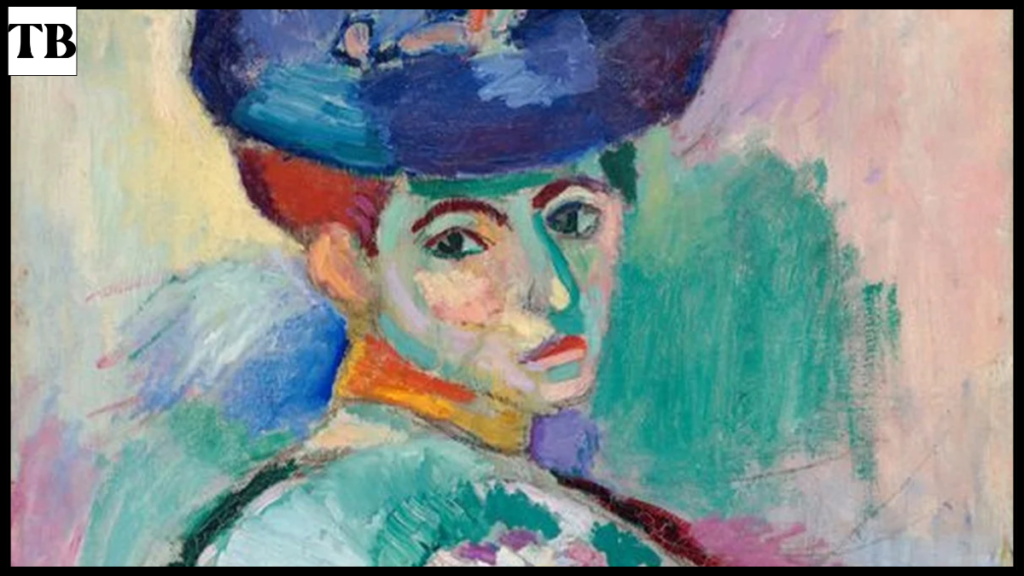
Henri Matisse is considered to be one of the most significant French artists in the 20th century owing to his brilliant use of colors, shapes, and designs. He was a painter, drawer, sculptor, printmaker and creator of revolutionary paper cutouts. Through his colorful pieces in the Fauvist phase and other masterpieces like ‘The Snail’ and ‘Blue Nude II’, his artistic approach varied throughout his career. He demonstrated how art could speak using colors, rhythm and simplified forms. His artworks have been very popular among art students, collectors, museum visitors and interior designers.
Henri Matisse Art Style and Artistic Development
Matisse was born in France in 1869 and developed a reputation as a leading figure associated with Fauvism. His early mature work challenged traditional expectations about realistic colour and representation. Rather than using colour simply to reproduce what he saw, he often used strong tones to create mood, rhythm and visual structure. Works from this period demonstrate his interest in intense colour relationships and simplified forms. The Museum of Modern Art describes his career as a continuous search for artistic solutions through different methods, showing how his style developed rather than remaining fixed. His importance therefore comes not only from individual paintings but also from the way he continually experimented with artistic language.
As his career progressed, Matisse explored interiors, portraits, figures, landscapes and decorative patterns. During his years in Nice, he became particularly interested in richly decorated rooms, textiles, models and carefully arranged objects. His later work often became more simplified, with large areas of colour and carefully controlled shapes replacing detailed naturalistic description. In the 1930s, for example, he produced Woman in Blue (The Large Blue Robe and Mimosas), showing how colour and decorative structure remained central to his artistic development.
The later part of his career brought another major transformation. Matisse began creating gouache-painted paper cut-outs, eventually producing compositions in which scissors became an important artistic tool. This technique allowed him to arrange colour and shape directly on a surface, creating designs that could be changed before being fixed into their final form. The cut-outs are not simply colourful decorations; they represent a significant development in his approach to drawing, composition and abstraction.
Famous Henri Matisse Artwork and Major Paintings
When people search for famous Matisse paintings, they often expect colourful portraits, reclining figures, interiors and decorative scenes. However, his best-known works cover a much wider range of subjects and periods. The Joy of Life, The Red Studio, The Dance, Woman in Blue and The Snail are among the works frequently discussed when studying his career. Each reflects a different aspect of his artistic development. Some focus on the relationship between figures and space, while others place greater emphasis on pattern, colour or simplified geometric forms.
His use of colour is particularly important when understanding why his paintings look so distinctive. Matisse could use a blue, red, green or yellow area as part of the structure of an image rather than treating it merely as a realistic description of an object. This approach became especially important in his mature work. Instead of relying heavily on conventional shading and modelling, he often allowed flat areas of colour to organise the composition. His work demonstrates how a painting can communicate through colour relationships, decorative rhythm and carefully placed shapes.
One important example is Woman in Blue (The Large Blue Robe and Mimosas) from 1937. The painting belongs to a period when Matisse returned to greater formal simplicity while continuing to investigate variations on familiar subjects. MoMA identifies it as part of his 1930–43 period, alongside works such as The Pink Nude, Woman in a Purple Robe with Ranunculi and The Rumanian Blouse.
Henri Matisse Prints, Blue Lady and Blue Nude Works
Matisse was also a highly productive printmaker, and his prints deserve attention alongside his paintings. The Museum of Modern Art records that he worked in printmaking for more than five decades and produced more than 800 intaglios, lithographs, woodcuts, linoleum cuts and monotypes. He viewed printmaking partly as an extension of drawing, which helps explain why many of his prints have a direct and economical quality. His printmaking was not simply a way of reproducing paintings; it became an independent part of his creative practice.
Examples include Large Nude from 1906 and several lithographs from the 1920s. MoMA records Large Nude as a 1906 lithograph from an edition of 50. It also holds Nude with Blue Cushion from 1924 and Nude with Blue Cushion Beside a Fireplace from 1925, both lithographs with editions of 50. These works demonstrate how Matisse could translate his interest in the human figure into a more economical printed form.
The search phrase “Henri Matisse blue lady” can also lead readers towards Woman in Blue, particularly the 1937 painting Woman in Blue (The Large Blue Robe and Mimosas). It is useful to distinguish this informal search wording from official artwork titles. Matisse also created several important blue-themed figure works, including Blue Nude compositions from his later cut-out period. Blue was not simply a favourite colour for him; it could help create contrast, structure and visual balance within a composition.
Henri Matisse Artwork The Snail and His Paper Cut-Outs
The Snail is one of the clearest examples of Matisse’s late cut-out technique. Created in 1953, it was made from gouache-painted paper that was cut and pasted, then mounted on canvas. Tate describes it as one of the last and largest works in his final series of cut-outs. The composition takes inspiration from the spiral form of a snail shell, but Matisse transformed the natural subject into a carefully arranged abstract pattern of coloured shapes.
The structure of The Snail shows why his late work remains so influential. Rather than carefully painting every detail of an animal, Matisse reduced the idea to colour, shape, proportion and movement. The central arrangement creates a strong sense of rotation, while contrasting colours make the composition immediately noticeable. Tate notes that Matisse used complementary colour pairs, including red and green, orange and blue, and yellow and mauve, to create a vibrant visual effect.
The technique also explains why his paper cut-outs are so important in art history. Matisse was able to create forms by cutting painted sheets of paper rather than building every image through traditional brushwork. Tate notes that his assistants painted sheets of paper in gouache, which Matisse then cut into shapes. This method allowed him to work with colour and composition in an unusually direct way. The Snail therefore represents more than a simple picture of an animal; it demonstrates a late artistic language based on reduction, rhythm and bold colour.
Henri Matisse Artwork Price, Prints, Benefits and Is It Worth Studying?
The price of a Matisse work can vary enormously depending on what is being purchased. An original painting, an original limited-edition print, a later reproduction and a museum-quality decorative print are completely different categories. Buyers should therefore avoid treating every item carrying Matisse’s name as having comparable value. For an original work, factors such as authenticity, provenance, condition, medium, date, rarity, exhibition history and previous ownership can all affect its market position. For an editioned print, the edition size, printing process, condition and documentation can also matter.
People searching for affordable Henri Matisse prints may find museum reproductions and decorative editions at prices far below those associated with original works. For example, Tate has offered reproductions of The Snail in different formats, including smaller art prints and larger giclée versions. These are reproductions rather than the original 1953 artwork, so their prices should not be confused with the value of an original Matisse work.
The main reasons people study or display Matisse’s work include:
- Colour: His use of intense and contrasting colours provides useful lessons in visual balance.
- Composition: His simplified arrangements show how fewer elements can create a strong image.
- Decorative design: Patterns, interiors and textiles play an important role throughout his career.
- Modern art history: His development from Fauvism to late cut-outs illustrates major changes in twentieth-century art.
- Printmaking: His extensive work across lithography, etching, woodcut and other techniques makes his graphic work valuable for study.
- Interior design: His bold shapes and colours remain relevant to contemporary decorative spaces.
For someone interested in art, design or visual culture, studying Matisse can be particularly useful because his career demonstrates that an artist does not need to remain within one style. His work moved from expressive painting towards increasingly simplified forms and eventually large-scale cut-outs. That progression makes his career useful for understanding experimentation, artistic development and the relationship between traditional and modern techniques.
- Also Read. Henry Cavill Movies TV Shows and Career
(FAQs)
What is Henri Matisse famous for?
Henri Matisse is famous for his bold use of colour, expressive shapes, decorative compositions and innovative paper cut-outs. He was also an important figure associated with Fauvism and produced paintings, drawings, sculptures and prints throughout his long career.
What was Henri Matisse’s art style?
Matisse’s style developed throughout his career. His early work was strongly associated with Fauvism and its intense colours. Later, he explored simplified forms, decorative patterns, interiors, portraits and large paper cut-outs.
What is The Snail by Henri Matisse?
The Snail is a large cut-out created in 1953. Matisse used pieces of brightly coloured, gouache-painted paper to create an abstract composition inspired by the spiral shape of a snail shell.
What are Henri Matisse prints?
Henri Matisse prints include lithographs, etchings, woodcuts, linoleum cuts and monotypes. He worked in printmaking for more than five decades, making prints an important part of his wider artistic career.
How much does Henri Matisse artwork cost?
Prices vary greatly depending on whether the item is an original painting, an original print, a limited edition or a reproduction. Authenticity, provenance, condition, rarity, medium and edition size can all affect the price.
Conclusion
Henri Matisse is still a significant artist in modern times owing to his bold use of color, shape, and composition. Through his career, he continued to innovate in areas such as Fauvist painting, portraiture, and even through printmaking and paper cut-out technique. His works like The Snail, Woman in Blue, and the popular blue nudes are examples of his innovative use of simple shapes and bold colors that give a visually appealing experience. The artist’s influence is seen in painting, illustration, interior decoration, and even in contemporary artworks. No matter whether you want to learn more about Matisse or get any reproduction of his works for decoration, you will find much inspiration here.