


Leonardo da Vinci was one of the most remarkable artists of the Italian Renaissance. His paintings, including the Mona Lisa and The Last Supper, continue to fascinate people because of their lifelike figures, subtle expressions and careful use of light. Yet his achievements extend far beyond a few famous masterpieces. Leonardo studied anatomy, explored nature, designed machines and filled notebooks with ideas that connected art with science. His work changed how artists approached portraiture, religious scenes and the human form. This guide explores his most important paintings, explains their meanings, examines his artistic techniques and answers common questions about his life and enduring influence.
Who Was Leonardo da Vinci?
Leonardo da Vinci was born on 15 April 1452 near Vinci, a town in Tuscany, Italy. He lived during the Renaissance, a period when artists and scholars explored new ideas about the natural world, human anatomy, mathematics, architecture and classical learning.
As a young man, Leonardo trained in Florence in the workshop of Andrea del Verrocchio. He developed skills in drawing and painting while learning about other artistic crafts. In the early 1480s, he moved to Milan, where he worked for powerful patrons and developed some of his most ambitious projects.
Leonardo later returned to Florence, spent time in Rome and eventually moved to France. He died at Amboise on 2 May 1519, leaving behind paintings, drawings, notebooks and unfinished projects that continue to interest historians and artists.
What made Leonardo unusual was his desire to understand how things worked. He examined muscles and bones, observed plants and animals, studied flowing water and explored how light affected the appearance of objects. These investigations helped him create figures that looked convincing and landscapes that appeared to stretch into the distance.
He also treated drawing as a way to investigate ideas. His notebooks contain sketches of machines, anatomical studies, architectural designs and observations of nature. They reveal how he connected creative work with scientific curiosity.
Although relatively few finished paintings survive, Leonardo’s influence remains central to the history of Western art. His work helped develop new approaches to composition, perspective, light and human expression.
What Are Leonardo da Vinci’s Most Famous Paintings?
Leonardo’s best-known paintings cover portraiture, religious subjects and scenes that explore human behaviour.
Each work demonstrates a different part of his artistic approach:
- Mona Lisa: A famous portrait known for its subtle smile, softly blended tones and distant landscape.
- The Last Supper: A religious mural showing Jesus announcing that one of his disciples will betray him.
- Virgin of the Rocks: A composition featuring the Virgin Mary, the infant Jesus, John the Baptist and an angel in a rocky setting.
- Lady with an Ermine: A portrait widely identified as Cecilia Gallerani, recognised for its natural pose and sense of movement.
- Ginevra de’ Benci: An early portrait that shows Leonardo’s interest in facial expression and landscape.
- The Virgin and Child with Saint Anne: A painting that brings Mary, Jesus and Saint Anne together in a connected composition.
- Saint John the Baptist: A religious image that uses a dark background and soft lighting to focus attention on the figure.
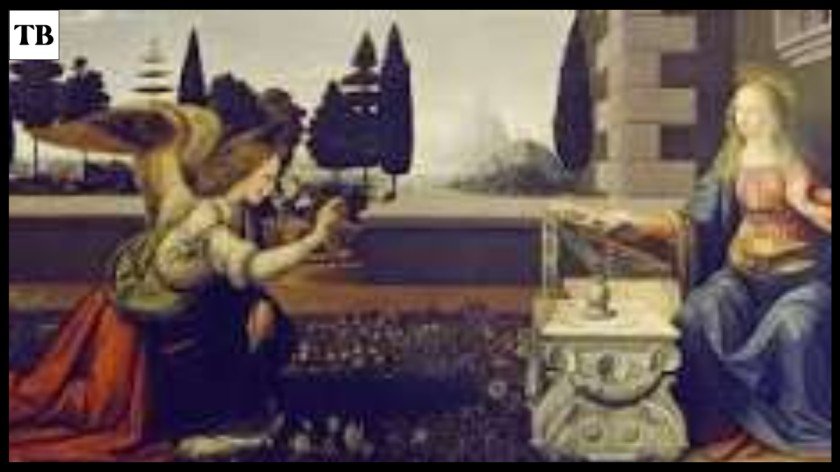
- Annunciation: A painting of the angel Gabriel delivering the news to Mary that she will give birth to Jesus.
These works are important for more than their fame. Leonardo paid close attention to how figures relate to one another, how light falls across a face and how a landscape can create depth. His paintings often encourage viewers to look carefully rather than reveal every detail immediately.
However, the authorship of some paintings associated with Leonardo remains disputed. Renaissance artists sometimes worked with assistants, and workshop members could help complete compositions. Historians therefore consider historical records, painting materials, style and technical evidence when deciding how a work relates to Leonardo.
Mona Lisa: Meaning, Mystery and Artistic Technique
The Mona Lisa is widely considered Leonardo’s most famous painting. It depicts a woman traditionally identified as Lisa Gherardini, who lived in Florence. Leonardo is believed to have begun the portrait around 1503, although he may have continued refining it over several years.
The sitter’s expression is central to the painting’s appeal. Her smile appears subtle, making it difficult to decide exactly what she feels. Leonardo avoided exaggerated emotion and instead used small changes around the mouth, eyes and cheeks to create a convincing face.
One of the painting’s defining features is sfumato, a technique that blends tones gradually rather than separating them with hard outlines. This soft transition between light and shade helps the face appear rounded and natural.
The landscape behind the sitter also plays an important role. Winding paths, water and distant mountains create a sense of space. Leonardo made distant features less distinct, allowing the background to suggest depth without distracting from the portrait.
The painting became even more famous after it was stolen from the Louvre in 1911. It was recovered in 1913 and returned to the museum. Its history, technical qualities and mysterious expression have all contributed to its international reputation.
The Mona Lisa demonstrates Leonardo’s ability to create a strong sense of presence through careful observation. Rather than relying on elaborate decoration, he used light, posture and expression to make the sitter feel almost alive.
The Last Supper: Story, Composition and Religious Meaning
The Last Supper depicts a key moment in Christian tradition. During his final meal with his disciples, Jesus announces that one of them will betray him. Leonardo focuses on the immediate reaction, showing how each person responds through movement, gesture and facial expression.
Some disciples turn towards their companions, while others appear shocked or question what they have heard. Their different reactions give the scene emotional energy without making the composition feel chaotic.
Jesus sits at the centre, providing a clear focus for the viewer. The lines of the room lead towards his figure, while the windows behind him create a balanced background. The table runs across the painting and organises the group into a readable scene.
Leonardo created the mural during the 1490s in the refectory of Santa Maria delle Grazie in Milan. He experimented with a painting method rather than using the traditional fresco process in its usual form. Unfortunately, the surface began to deteriorate relatively early, and later restoration work has tried to preserve the remaining image.
Despite its fragile condition, the painting remains a major achievement in Renaissance art. Leonardo used composition and human behaviour to communicate a story that viewers could understand even without knowing every detail of the biblical account.
The work also demonstrates his interest in the relationship between physical gestures and emotion. Each figure contributes to the scene, yet the overall arrangement remains carefully controlled.
Virgin of the Rocks and Leonardo’s Religious Paintings
The Virgin of the Rocks is one of Leonardo’s most distinctive religious paintings. It depicts Mary, the infant Jesus, John the Baptist and an angel within a rocky landscape. The figures communicate through their gestures and glances, creating a quiet scene that rewards close attention.
The natural setting is central to the painting’s meaning and atmosphere. Rocks, plants and distant water surround the figures, while changes in light and colour make the landscape appear spacious. Leonardo used the environment to support the religious story rather than treating it as a simple background.
Two principal versions of the composition are known. One is held at the Louvre in Paris, while the other belongs to London’s National Gallery. Differences between the versions and their production histories have attracted considerable scholarly attention.
The painting also demonstrates Leonardo’s use of sfumato and aerial perspective. The figures emerge softly from darker areas, while distant features appear paler and less distinct. These effects help connect the figures with the surrounding landscape.
Other religious works, including The Virgin and Child with Saint Anne and the Annunciation, show his interest in relationships, gestures and natural forms. Rather than arranging figures in rigid poses, Leonardo often created compositions in which people appear to interact with one another.
His religious paintings therefore combine traditional Christian subjects with close observation of the human body and natural world.
Lady with an Ermine and Leonardo’s Portraits
Lady with an Ermine is widely identified as a portrait of Cecilia Gallerani, a woman associated with the court of Milan. The sitter holds an ermine while turning her head slightly, creating a sense that something outside the painting has caught her attention.
The movement makes the portrait feel natural rather than stiff. Leonardo carefully arranged the sitter’s hands, head and shoulders, while the animal adds another point of interest. Its symbolic meaning has been interpreted in different ways, so it is best understood alongside the historical context rather than through one definite explanation.
Ginevra de’ Benci offers another example of Leonardo’s portraiture. The sitter appears against a detailed background, and the combination of face, clothing and landscape gives the composition a carefully balanced appearance.
Leonardo’s portraits often suggest character through small details. A turn of the head, the position of a hand or a change in expression can make a sitter appear thoughtful and individual. These choices helped move portraiture beyond a simple record of appearance.
His approach influenced later artists, who increasingly explored how posture, expression and setting could contribute to a portrait’s meaning.
Salvator Mundi: Jesus, Art History and a Disputed Attribution
Salvator Mundi, meaning “Saviour of the World”, depicts Jesus facing forward, raising one hand in blessing and holding a transparent orb in the other. The painting belongs to the tradition of Christian images that present Christ as the saviour of humanity.
The work attracted international attention when it sold at auction in 2017 for approximately US$450.3 million, including the buyer’s premium. The sale made it one of the most expensive paintings ever sold at auction.
However, the painting’s attribution remains controversial. Some specialists support the connection with Leonardo, while others question how much of the surviving work was completed by his own hand. Its condition, restoration history and relationship to other works all contribute to the debate.
Attribution can be difficult for Renaissance paintings because artists often worked with assistants and workshop members. A composition might reflect a master’s design without every part being painted by that person.
For this reason, a painting’s market value does not establish its authorship. Historians examine technical evidence, historical records and artistic features, while acknowledging areas where the evidence remains uncertain.
The debate surrounding Salvator Mundi demonstrates why responsible art writing must distinguish between confirmed information and scholarly disagreement.
Leonardo da Vinci’s Drawings and the Vitruvian Man
Leonardo’s drawings reveal the ideas behind his paintings and his wider interests. His notebooks contain studies of anatomy, machines, plants, flowing water, buildings and human movement. He used drawing to record observations, test ideas and develop compositions.
The Vitruvian Man is among his most recognised drawings. It shows a male figure positioned within a circle and a square, exploring the relationship between human proportions and geometric forms. Leonardo drew on ideas associated with the ancient Roman architect Vitruvius.
His anatomical studies are equally revealing. He examined bones, muscles and organs to understand the structure of the body. These observations helped him represent figures more convincingly and explore how movement affects posture.
Leonardo also investigated engineering and flight. His notebooks include designs for mechanical devices and flying machines, although many of these ideas were never built or tested during his lifetime.
Some pages contain mirror writing, which runs from right to left. The exact reason for this practice is not established, so explanations should be treated as theories rather than proven facts.
These drawings show that Leonardo’s achievements extended well beyond painting. They reveal a working method based on close observation, experimentation and a desire to understand the principles behind the natural world.
What Made Leonardo da Vinci’s Painting Style Unique?
Leonardo developed techniques that helped make his paintings appear realistic, atmospheric and emotionally convincing.
His approach combined careful study with deliberate choices about light, colour and composition:
- Sfumato: Blends tones gradually to soften outlines and create subtle transitions between light and shadow.
- Chiaroscuro: Uses contrasts between light and dark to give figures a stronger sense of volume.
- Linear perspective: Arranges lines and architectural features to create an impression of depth.
- Aerial perspective: Makes distant landscapes appear softer, paler and less distinct than nearby objects.
- Anatomical observation: Uses knowledge of the human body to improve the structure and movement of figures.
- Compositional balance: Places figures and objects so that the viewer’s attention moves through the scene naturally.
- Study of expression: Uses facial details, posture and gestures to communicate emotion.
These techniques supported one another. Leonardo’s anatomical knowledge helped him represent the body, while his study of light gave figures a convincing sense of shape. Perspective created depth, and careful composition made complex scenes easier to follow.
His paintings may look effortless, but their effects came from years of observation and experimentation. Leonardo’s approach helped shape Renaissance painting and remains an important subject for artists, students and historians.
Did Leonardo da Vinci Paint Starry Night?
No. Vincent van Gogh painted The Starry Night in 1889, more than three centuries after Leonardo’s death. The painting belongs to Post-Impressionism, while Leonardo worked during the Italian Renaissance.
The two artists used different approaches. Leonardo often blended colours and tones to create smooth transitions and realistic forms. Van Gogh used expressive brushstrokes, strong colours and swirling shapes to communicate movement and atmosphere.
Both artists studied the world around them, but their artistic aims and methods differed. Leonardo explored the structure of what he observed, while Van Gogh often used colour and brushwork to express a personal response to his surroundings.
Understanding this distinction helps place famous paintings in their correct historical context. Although both artists have had a lasting influence, The Starry Night is not part of Leonardo’s body of work.
Leonardo da Vinci Art Books and Research Sources
Books about Leonardo da Vinci range from accessible introductions to detailed academic studies. Some explore his life and historical background, while others focus on individual paintings, drawings or scientific interests.
An introductory art history book can explain the Renaissance and the patrons who supported Leonardo. A guide to his paintings may discuss composition, symbolism, restoration and the historical background of specific works.
Illustrated collections of drawings and notebooks are especially useful for readers interested in his creative process. They show how he studied anatomy, explored engineering and developed ideas through observation.
For more detailed research, look for books that explain provenance, meaning the history of a work’s ownership, and discuss technical examination. These details can help readers understand why experts agree about some paintings but continue to debate others.
Wikipedia can be a starting point for general information, but readers should compare its summaries with museum catalogues and specialist publications when accuracy matters. Reliable sources should distinguish established facts from theories and explain uncertainty where it exists.
Choosing a book that matches your level of knowledge makes the subject easier to understand. Beginners may prefer an illustrated introduction, while students and researchers may benefit from more detailed discussions of attribution, conservation and Renaissance history.
Where Can You See Leonardo da Vinci’s Paintings?
Several museums and historic sites in Europe hold paintings or drawings by Leonardo.
Seeing an original work can help visitors appreciate its scale, surface, details and condition.
- The National Gallery, London: Holds the London version of the Virgin of the Rocks.
- The Louvre, Paris: Houses the Mona Lisa and the Paris version of the Virgin of the Rocks.
- Santa Maria delle Grazie, Milan: The historic location of The Last Supper.
- Czartoryski Museum, Kraków: Displays Lady with an Ermine.
- The Royal Collection, United Kingdom: Holds an important group of Leonardo’s drawings and studies, although individual works are not always on public display.
- Uffizi Gallery, Florence: Offers a wider context for understanding Renaissance art and Leonardo’s early artistic environment.
Museum displays can change because of conservation, loans and temporary exhibitions. Visitors should check current arrangements before travelling, particularly when planning to see a specific work.
Museum catalogues can also explain a painting’s date, materials, ownership history and attribution. This information adds context that may be missing from short descriptions or reproductions.
Why Is Leonardo da Vinci’s Art Still Important Today?
Leonardo remains important because he combined artistic skill with a deep interest in the natural world. His paintings reveal careful observation of faces, bodies, light and space, while his notebooks show how he explored questions about science and engineering.
His influence extends across portraiture, religious painting and drawing. Artists continue to study his use of perspective, shading and composition, while his notebooks attract readers interested in the relationship between creativity and scientific thought.
His career also demonstrates that artistic innovation often involves experimentation. Leonardo reconsidered compositions, tested painting methods and left some projects unfinished. Even these incomplete works can reveal how he developed ideas and worked through difficult problems.
For modern readers, his legacy offers a valuable lesson: creative work can become more meaningful when it is supported by curiosity, careful observation and a willingness to question assumptions.
- Also Read. National Gallery London What to See
(FAQs)
What is Leonardo da Vinci’s most famous artwork?
The Mona Lisa is widely regarded as Leonardo da Vinci’s most famous painting. It is known for its subtle expression, soft shading and mysterious smile.
What are Leonardo da Vinci’s most important paintings?
His best-known paintings include the Mona Lisa, The Last Supper and Virgin of the Rocks. Each demonstrates his skill in composition, observation and the use of light.
Where can you see Leonardo da Vinci’s artwork?
The Mona Lisa is displayed at the Louvre Museum in Paris, while The Last Supper is in Milan, Italy. Other works are held in major art collections around the world.
What made Leonardo da Vinci’s art unique?
Leonardo combined careful observation of nature with scientific study and artistic skill. His use of soft shading, realistic expressions and balanced compositions helped shape Renaissance painting.
Did Leonardo da Vinci create paintings and drawings?
Yes. He produced paintings, detailed drawings, anatomical studies, engineering designs and scientific notes. His surviving notebooks reveal his wide-ranging curiosity and creative approach.
Conclusion
Leonardo da Vinci’s paintings and drawings reveal an artist whose curiosity reached far beyond the traditional boundaries of art. The Mona Lisa demonstrates his subtle approach to portraiture, while The Last Supper shows how composition and gesture can tell a powerful story. His religious paintings reveal his interest in human relationships and the natural world, while his notebooks document his investigations into anatomy, engineering and movement. Questions surrounding unfinished works and disputed attributions also show why careful research matters when studying art history. Exploring his legacy means looking beyond famous titles to understand how his work was made, what it communicates and why it continues to influence artists and audiences today.