


Claude Monet was a French painter whose work transformed the way artists represented light, colour and the natural world. Born in Paris in 1840, he became a leading figure in Impressionism, a movement that challenged traditional approaches to painting. His famous works include Impression, Sunrise, Water Lilies, Haystacks and Rouen Cathedral. Rather than reproduce every detail, he explored how a scene changed with the weather, season and time of day. His garden at Giverny became a lifelong source of inspiration, while his paintings of the River Thames revealed his fascination with London’s changing atmosphere. Today, his work remains central to art history and attracts museum visitors, collectors and new generations of art lovers.
Who Was Claude Monet? Early Life and Artistic Beginnings
Oscar-Claude Monet was born on 14 November 1840 in Paris, France. His family moved to Le Havre, a coastal town in Normandy, when he was a child. The sea, changing skies and open landscapes around the town gave him an early interest in the natural world.
As a teenager, he became known locally for his caricatures. These drawings showed his ability to observe people and capture their features with a few confident lines. However, he wanted to develop his skills beyond portrait sketches and build a career as a painter.
A meeting with landscape artist Eugène Boudin proved a turning point. Boudin encouraged him to paint outdoors, a practice known as plein air painting. Working outside allowed artists to observe changing light and weather directly instead of relying entirely on studio sketches.
In 1859, he travelled to Paris to pursue his artistic ambitions. He encountered new ideas, met fellow painters and began to question the strict rules of academic art. His early career brought financial difficulties and periods of uncertainty, but he continued to experiment.
His experiences in Normandy and Paris helped shape his artistic outlook. He became increasingly interested in how people see the world, particularly the way light changes the colours and appearance of familiar places.
How Impressionism Changed the History of Art
Impressionism emerged in France during the nineteenth century. At the time, official art institutions often preferred carefully finished paintings of historical events, religious stories and classical subjects. A group of artists wanted to explore modern life and represent the world in a more immediate way.
They painted rivers, gardens, railway stations, streets and people enjoying everyday activities. Their brushstrokes often remained visible, and their colours could appear brighter than those in traditional academic paintings. Instead of hiding the process of painting, they allowed the viewer to see how marks of paint created the image.
The movement gained its name after an independent exhibition in Paris in 1874. One of the paintings on display was Impression, Sunrise. Some critics initially used the word “Impressionism” as an insult, suggesting that the pictures looked like unfinished impressions rather than complete works. The artists eventually adopted the term, and it became associated with one of the most influential movements in modern art.
The central idea was that a painting could capture the experience of a moment without recording every detail. Sunlight, mist, reflections and movement became important subjects in their own right.
This approach changed the way artists thought about landscape painting. A harbour at dawn, a riverbank in summer or a garden after rain could provide as much artistic interest as a grand historical scene. Impressionism also helped open the door to later movements that placed greater emphasis on colour, personal perception and experimentation.
What Is the Impressionist Art Style Known For?
The style is best known for visible brushstrokes, carefully observed light and colours that change according to the surrounding conditions. The paintings often look different from close up and from a distance. Up close, individual marks may seem separate, but they combine to create a convincing impression of water, trees, buildings or sky.
Colour plays a central role. Shadows do not always appear black or grey; they may contain blue, violet or green. Reflections can combine colours from several parts of a landscape, while mist softens the edges of objects and creates a sense of depth.
The artist also recognised that the appearance of a subject depends on its environment. A building can seem warm under evening sunlight and cool beneath a cloudy sky. A pond can reflect so much of the surrounding landscape that it becomes difficult to separate the water from the images above it.
The main features of this approach include:
- Changing light: Sunlight, clouds, mist and weather influence the colours and atmosphere of a scene.
- Visible brushwork: Short, expressive marks suggest movement and natural textures.
- Colour contrast: Colours work together to create depth, energy and mood.
- Outdoor observation: Painting directly from nature helps capture changing conditions.
- Repeated subjects: Returning to the same place reveals how light changes its appearance.
- Experimental composition: Later paintings sometimes reduce traditional perspective and focus on the surface of the canvas.
Although these paintings can look spontaneous, they often required careful observation and repeated work. The artist sometimes painted several canvases of the same subject at once, moving between them as the light changed. This method helped him explore subtle differences that might otherwise disappear before he could record them.
Famous Paintings and Their Meaning
The most famous works demonstrate how a familiar subject can change with the time of day, season and weather. Some capture a particular moment, while others belong to series that examine the same subject repeatedly.
Impression, Sunrise
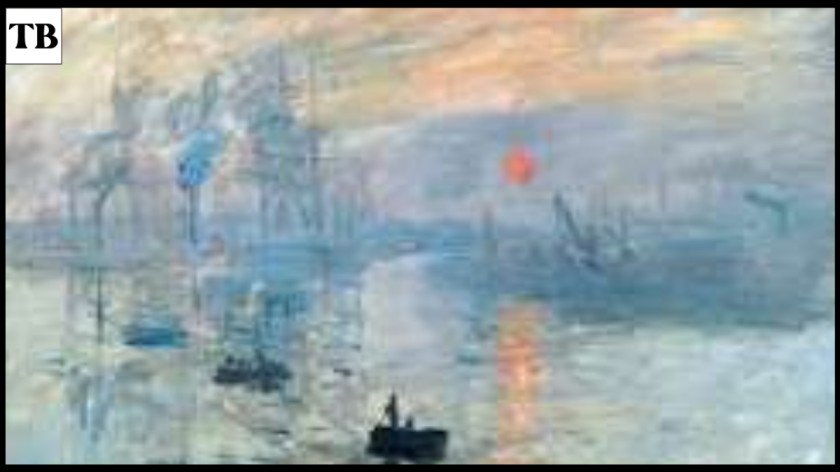
Painted in 1872, Impression, Sunrise depicts the harbour at Le Havre in the early morning. An orange sun stands out against a misty blue-grey sky, while boats and industrial structures appear through the haze.
The loose brushwork captures the atmosphere of the harbour rather than describing every object in detail. The painting became especially important because its title inspired the name of Impressionism. It shows how a limited range of colours and expressive marks can communicate the feeling of a place.
Water Lilies
The Water Lilies series explores the pond in the artist’s garden at Giverny. The paintings show floating flowers, lily pads and reflections in colours that shift with the light. Some include the Japanese bridge and surrounding plants, while others focus almost entirely on the water’s surface.
The later compositions became increasingly experimental. Many contain little or no traditional horizon, encouraging viewers to look across the canvas rather than into a clearly defined landscape. These works helped influence later artists who explored abstraction and the expressive potential of colour.
Haystacks
The Haystacks series features stacks of harvested grain in fields near Giverny. Although the subject remains similar, the colours change with the light and weather.
A haystack may appear golden under bright sunlight, pink in the evening or blue and violet in colder conditions. These paintings show that an object does not have one fixed appearance. Its visual character changes according to the light around it.
Rouen Cathedral
The Rouen Cathedral series focuses on the building’s elaborate stone façade. The artist painted it under different lighting conditions, exploring how sunshine and shadow changed its colour and texture.
The cathedral remains recognisable in each painting, yet the atmosphere can vary greatly. The series demonstrates that even a solid architectural structure can appear different from one moment to the next.
The Japanese Bridge
The Japanese bridge in the Giverny garden appears in several paintings. Its curved shape contrasts with the surrounding plants and the reflective pond. As the garden matured, the bridge became increasingly surrounded by vegetation, offering new combinations of colour, texture and form.
Together, these works reveal a consistent interest in observation. Rather than constantly searching for new subjects, the artist found fresh ideas by returning to familiar places and studying them under different conditions.
Water Lilies: The Garden Behind the Masterpieces
The Water Lilies paintings grew from a garden developed at the artist’s home in Giverny, a village in Normandy. He moved there in 1883 and bought the house and grounds in 1890. In the following years, he acquired more land and created a water garden with a pond, flowers and a Japanese-style bridge.
The garden became both a personal retreat and a carefully planned artistic environment. He paid close attention to the plants, colours and views around the pond. Water lilies provided bright points of colour, while the surface reflected clouds, trees and the changing sky.
These reflections created an unusual challenge. The water could appear almost flat in one area and deep in another, depending on the colours and brushstrokes. The flowers and their reflections also blurred the distinction between solid objects and shifting light.
Over time, the compositions moved away from traditional landscape views. Earlier paintings included the bridge, pond banks and surrounding plants. Later works often concentrated on the water itself, allowing reflections and lily pads to fill the canvas.
The scale of the project was remarkable. The artist produced around 250 paintings of the water garden. He also planned monumental decorative works that would surround viewers with the painted pond. Twenty-two large canvases were installed in the Musée de l’Orangerie in Paris in 1927, after his death.
The series remains important because it shows how a recognisable natural subject can lead to bold artistic experimentation. The paintings invite viewers to experience colour, reflection and movement rather than simply identify objects in a landscape.
Claude Monet and London: The Thames Paintings
London played an important role in his artistic development. During the Franco-Prussian War, he lived in the British capital from 1870 to 1871. He later returned for further visits around the turn of the twentieth century.
The city’s fog, riverside buildings and changing light fascinated him. Rather than treating mist as an obstacle to clear vision, he explored how it softened buildings and brought different parts of a landscape together. The River Thames offered a particularly rich subject because its appearance changed with the weather, reflections and movement of the water.
His London paintings include views of the Houses of Parliament, Waterloo Bridge and Charing Cross Bridge. These works often show familiar landmarks through layers of haze and colour. The buildings may be recognisable, but their outlines seem to dissolve into the atmosphere.
This approach links the London series with his paintings of haystacks and Rouen Cathedral. In each case, he returned to a subject to explore how light transformed it. The Thames paintings also show that his interest in nature did not exclude modern urban life.
For British audiences, these works offer a distinctive view of London at a time when the city was growing rapidly. They capture both its architecture and the atmospheric conditions that gave the river and skyline their changing appearance.
Family Life, Health and Later Years
The artist’s personal life included financial hardship, family responsibilities and significant losses. He married Camille Doncieux in 1870, and they had two sons, Jean and Michel. Camille died in 1879 after a long illness.
In 1892, he married Alice Hoschedé, who had become part of his household during an earlier period of difficulty. Alice died in 1911. These losses affected him deeply, yet he continued to work and develop his garden at Giverny.
His career had not always been financially secure. During his early years, he struggled to support his family and establish his reputation. Over time, however, growing recognition and sales allowed him to devote more attention to his work and the gardens that inspired it.
Later in life, cataracts affected his eyesight and made it harder to distinguish colours accurately. Painting became more challenging, but he continued to work on the water garden and his large decorative canvases. His later paintings often use broader strokes and more intense colours, although it is important not to attribute every stylistic change to his eyesight alone.
He died in Giverny on 5 December 1926, aged 86. His final years were marked by continuing artistic ambition, and his garden remained central to his work until the end of his life.
How Much Are Original Paintings Worth?
The value of an original painting depends on its subject, size, date, condition, provenance and importance within the artist’s career. There is no single price that applies to every work. A major painting from a celebrated series may be worth far more than a smaller or less prominent piece.
In May 2019, Meules, one of the Haystacks paintings, sold at Sotheby’s in New York for approximately US$110.7 million, including the buyer’s premium. This exceptional result illustrates the international demand for important works, but it should not be treated as a typical price for every painting.
Buyers must also distinguish between original paintings, prints, drawings and works attributed to the artist. Each category has a different market. A reproduction may resemble a famous painting, but it does not carry the same value as an authenticated original.
Anyone considering a purchase should examine the artwork’s provenance, condition and authentication history. Independent advice from a qualified art specialist or established auction house can help establish a realistic valuation. Online photographs and seller descriptions alone cannot prove authenticity.
Auction prices also change with market conditions and the availability of important works. Published sales results provide useful context, but they cannot guarantee what another painting will sell for.
(FAQs)
Who Was Claude Monet?
Claude Monet was a French painter born in 1840 and a leading figure in the Impressionist movement. He became famous for paintings that capture light, colour and the changing appearance of nature.
What Is Claude Monet Most Famous For?
He is best known for his Water Lilies series, as well as Impression, Sunrise and Woman with a Parasol. His work helped change the direction of modern painting.
Why Did Claude Monet Paint Water Lilies?
Monet painted water lilies to explore reflections, shifting light and colour. His garden pond at Giverny became a major source of inspiration during the later years of his career.
How Do You Pronounce Claude Monet?
In English, Claude Monet is commonly pronounced “KLOHD moh-NAY”. The surname’s final syllable sounds like the English word “nay”.
How Much Are Claude Monet Paintings Worth?
Original paintings can sell for millions, depending on their subject, history, condition and importance. In 2019, one of his Haystacks paintings sold for approximately $110.7 million at auction.
Conclusion
The work of this French painter helped change the course of modern art by showing how light, weather and colour shape the way people see the world. From Impression, Sunrise to the Water Lilies series, his paintings reveal how a familiar scene can look different from one moment to the next. His repeated studies of haystacks, cathedrals and London’s river views demonstrate a lasting interest in observation rather than simple description. His life also involved financial hardship, family loss and declining eyesight, yet he continued to experiment with ambitious compositions. Today, his paintings remain important to museums, collectors and people discovering Impressionism for the first time. His lasting contribution lies in encouraging viewers to look more closely at nature, architecture and the changing beauty of everyday scenes.