


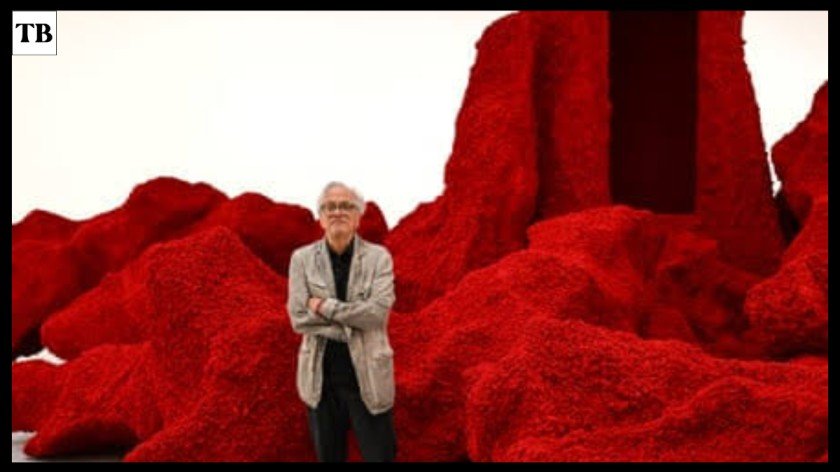
Anish Kapoor is an artist whose work can make you stop in your tracks and look twice. His sculptures play with colour, light, reflection and space, often creating a sense of wonder or mystery. Some pieces are huge and dramatic, while others feel quieter and more personal. From the famous Cloud Gate in Chicago to Sky Mirror and Marsyas, his work can be found in major collections and public spaces around the world. What makes his career especially interesting is the way he turns simple ideas into powerful experiences. His art continues to encourage people to look differently at the world around them.
Who Is Anish Kapoor?
The British-Indian contemporary artist was born in Mumbai in 1954 and later moved to Britain to study art. He attended Hornsey College of Art before continuing his studies at Chelsea School of Art. His career developed through a combination of gallery exhibitions, public commissions and large-scale installations. He is now associated with major contemporary art projects across Europe, North America and other parts of the world. His official biography records that he lives and works in London and Venice.
His early practice became known for strong pigments, simple forms and an interest in the relationship between objects and empty space. Rather than making sculpture that simply represents a person, building or familiar object, he often creates works that encourage viewers to question what they are seeing. Holes, curves, mirrors, colours and unusual surfaces appear repeatedly throughout his career. This approach makes the viewer an active part of the artwork. The experience can change depending on distance, lighting and movement.
His career has also demonstrated how contemporary sculpture can become part of public life. Works placed outside traditional museums can attract people who may not normally visit galleries. Cloud Gate in Chicago is a clear example because its reflective surface allows visitors to see themselves and the surrounding city. Other major projects have connected sculpture with architecture, engineering and landscape. This broad approach has helped establish the artist as an important figure in contemporary sculpture.
The Artist’s Style and Major Themes
The central themes in his work include colour, darkness, reflection, emptiness, infinity and the relationship between the visible and invisible. These ideas appear in different forms across several decades of his career. A simple curved surface can become an optical experience, while an apparently empty opening can appear unusually deep. Instead of giving viewers a fixed image, many works create uncertainty. This encourages people to spend more time looking rather than immediately searching for an explanation.
Colour plays a particularly important role in his artistic language. Rich reds, blues and powdered pigments can dominate the surface of a sculpture and change the way its form is perceived. In some works, the pigment appears to become part of the object rather than simply covering it. Darkness works in a similar way by reducing the visual information available to the eye. When edges and contours become difficult to see, viewers can become uncertain about the true shape or depth of a work.
Reflection is another recurring feature, especially in his polished stainless-steel sculptures. Mirrors capture buildings, people, clouds and surrounding landscapes, meaning that the environment becomes part of the artwork. His installations can also interact directly with architecture by occupying floors, walls, ceilings and large rooms. The Hayward Gallery exhibition in 2026 is particularly relevant because the Southbank Centre describes works interacting with the gallery’s architectural spaces. This relationship between sculpture and surroundings remains central to understanding his practice.
Famous Works and Sculptures
The list of famous works includes several sculptures that have become recognised landmarks. Cloud Gate in Chicago, popularly known as “The Bean”, is perhaps the most recognisable. Its polished stainless-steel surface reflects the skyline, visitors and surrounding park. Sky Mirror similarly uses reflection to transform the environment around it. These works show how a sculpture can continually change without physically moving.
Some of his most recognised works include:
- Cloud Gate – The famous reflective sculpture in Chicago, often called “The Bean.”
- Sky Mirror – A large concave mirror that reflects the sky and surrounding architecture.
- Marsyas – A monumental installation created from steel and PVC membrane for Tate Modern.
- Orbit – A huge sculpture created for the 2012 London Olympics.
- Descension – A dark, swirling vortex of continuously moving water.
- Svayambh – A striking red wax sculpture that changes as it moves through a gallery space.
- My Red Homeland – A large circular installation exploring colour, movement and destruction.
Marsyas is another major work and was created for the Turbine Hall at Tate Modern in London in 2002. Its enormous scale transformed the experience of the museum’s architecture and demonstrated the artist’s ability to work beyond conventional sculpture. Orbit, created for the 2012 Olympic Games in London, combined sculpture, engineering and public access. Descension takes a different approach by using a dark whirlpool of water to create the impression of an apparently bottomless space.
Other important works include Svayambh, My Red Homeland, Turning the World Upside Down, Leviathan and Non-Object (Spire). Together, these works demonstrate the wide range of materials and ideas explored throughout his career. Some pieces focus on colour, while others investigate mirrors, water, darkness or enormous architectural forms. His sculptures can therefore look very different from one another while still sharing an interest in perception. This variety is one reason his career remains important to students and contemporary art audiences.
Vantablack, Darkness and the Most Discussed Work
Vantablack became one of the most discussed materials associated with his artistic practice. The material is known for its extremely light-absorbing qualities, producing an unusually dark visual appearance. Its association with contemporary art created considerable public discussion about materials, artistic control and access. However, the subject represents only one part of a much larger career. His interest in darkness and the void existed long before the Vantablack debate.
Darkness has a particular role in his work because it can remove information from the viewer. A normally visible surface provides clues about shape, depth and texture through highlights and shadows. A very dark surface can reduce those clues, making a flat area appear deeper or making a three-dimensional object seem less certain. This connects with his broader interest in the void and the limits of human perception. The viewer is encouraged to question what is actually visible.
The Vantablack discussion can therefore be understood within a wider investigation of materials and perception. His career includes pigment, steel, mirrors, stone, water, paint and architectural structures, with each material offering different possibilities. Instead of treating materials simply as tools, he often makes their physical properties part of the meaning. This approach provides a useful lesson for art students because it shows how material choice can influence the emotional and visual experience of an artwork.
Hayward Gallery Exhibition 2026
The Hayward Gallery exhibition is one of the major London contemporary art exhibitions of 2026. It runs from 16 June to 18 October 2026 and brings together new and earlier works, including sculptures and paintings. The Southbank Centre describes the exhibition as filling the gallery and terraces with works that interact with the building. It is curated by Ralph Rugoff and represents an important return to the venue following the artist’s earlier major survey there. This makes the exhibition particularly relevant for anyone studying the development of his career.
The Hayward Gallery itself adds another important dimension to the experience. Its distinctive Brutalist architecture provides large concrete spaces that can accommodate monumental installations. Instead of simply displaying sculpture against white walls, the exhibition allows works to interact with floors, ceilings and other architectural features. This makes the building part of the viewing experience. Visitors can therefore study not only the artworks but also the relationship between sculpture and architecture.
The official Southbank Centre information lists standard admission at £22, with free entry for members. Regular opening hours are Tuesday to Friday from 10am to 6pm, Saturday from 10am to 8pm and Sunday from 10am to 6pm, with the gallery closed on Mondays. Visitors can get more from the exhibition by moving around the works slowly and observing how their perspective changes. This is particularly useful for reflective, dark and large-scale pieces because photographs cannot always communicate their full physical effect.
Books, Career and Legacy
Books and exhibition catalogues provide another useful way to explore the artist’s career. The official publications list includes a 2026 Hayward Gallery exhibition catalogue featuring contributions from Ralph Rugoff, Nancy Spector, Julia Kristeva, Sandhini Poddar and the artist himself. These publications can provide additional context about the ideas behind the sculptures. They are particularly useful for students who want more than a basic biography. Photographs also allow readers to compare works from different periods.
Another 2026 publication is Way Out Way In – Photographs by Anish Kapoor. The book features photographs made by the artist over five decades, accompanied by an essay by Christopher Bollas. It provides a different perspective on his creative interests and visual observations. Readers searching for an Anish Kapoor book may therefore find several options depending on whether they want exhibition information, critical essays or photography. Exhibition catalogues can also help readers understand individual works in greater historical context.
Questions about his wife, family and net worth frequently appear in online searches, but these subjects require careful treatment. Reliable professional sources focus much more heavily on his artistic career than on private financial or family details. Online net worth estimates can vary widely and should not be treated as confirmed figures without reliable documentation. Similarly, information about private relationships should come from credible published sources rather than unsupported claims. For research purposes, official biographies, museum records and exhibition catalogues provide a stronger foundation.
Why His Art Still Matters
His work remains relevant because it encourages people to reconsider ordinary ideas about space, objects and perception. A mirror can become a changing landscape, while a dark opening can create uncertainty about depth. A huge sculpture can also alter the way visitors understand an entire building or public space. These experiences show that sculpture does not have to tell a traditional story. It can instead create a physical situation that viewers experience for themselves.
The work also provides useful lessons for students, photographers, architects and emerging artists. Students can study how materials affect meaning, while photographers can explore reflection, distortion, light and composition. Architects can consider how art changes the experience of buildings and public spaces. Emerging artists can learn from the way simple ideas such as colour, emptiness and scale can become powerful when developed carefully. These practical lessons help explain why the work continues to attract attention.
The 2026 Hayward Gallery exhibition gives visitors a chance to see these ideas together rather than encountering individual works separately. New and earlier pieces can be compared for their treatment of colour, darkness, scale and space. Visitors do not need specialist knowledge to begin appreciating the exhibition. Looking carefully, changing position and noticing how the artwork affects the surrounding room can provide a useful starting point. The lasting appeal comes from making familiar visual experiences feel unexpected.
(FAQs)
Why is Anish Kapoor so famous?
He is known for large-scale sculptures exploring space, colour, reflection and perception. Famous works include Cloud Gate, Sky Mirror and Marsyas.
Why does Anish Kapoor have exclusive artistic rights to Vantablack?
Vantablack was licensed to him for exclusive artistic use. The arrangement attracted criticism from other artists and became a widely discussed art-world controversy.
What is Anish Kapoor’s most famous artwork?
Cloud Gate, popularly known as “The Bean”, is among his best-known works. Its polished surface reflects visitors, the park and Chicago’s surrounding skyline.
What was the backlash over Anish Kapoor and Vantablack?
The controversy focused on his exclusive artistic access to Vantablack. Critics argued that other artists should also have access to the distinctive material.
Where can you see his work in 2026?
His major Hayward Gallery exhibition in London runs from 16 June to 18 October 2026. It brings together new and earlier sculptures and paintings.
Conclusion
Anish Kapoor’s art has a way of making people stop, look and think. His sculptures can feel bold and mysterious, while works such as Cloud Gate, Sky Mirror and Marsyas show his interest in space, colour, reflection and emotion. Rather than simply telling visitors what to see, his work invites them to form their own impressions. The 2026 Hayward Gallery exhibition offers a chance to experience this approach through both new and earlier works. For anyone interested in modern sculpture, his career provides plenty to explore. Even after leaving the gallery, his unusual shapes, surfaces and ideas can stay in your mind for a long time.